
What Underlies the Solar Sunspot Cycles?
Most astronomers are not entirely in agreement (to say the least) in terms of understanding the mechanism(s) which likely underlie the solar sunspot and solar polar field reversal cycles. Magnetic fields are certainly involved with the main solar features. Coronal holes (in comparison to sunspots which are also magnetic features) are the less well known feature on the closest star. In short we don’t know what underlies the sunspot cycles, but that’s no indication we can’t!
In 1973, everything changed with respect to heliophysics. The view of the Sun and its structures had never before been seen in the stunning detail that was viewed from Skylab. Coronal holes were 
not understood when first discovered. Above image of polar coronal hole is available at https://www.history.nasa.gov/SP-402/ch6.htm.
Earth’s atmosphere largely filters out extreme UV light, hence space telescopes are required to view the rich UV chemical spectral bands.
Fast forward to 2022, and coronal holes are recognized as an important indicator of solar cycle progress. Coronal holes also contribute to Earthly geomagnetic storms, when high speed solar ionic winds reach Earth’s magnetic moment in space.
Above: Earth’s magnetohydrodynamic pressure from ~12 Earth diameters; Image source: https://www.swpc.noaa.gov/products/geospace-magnetosphere-movies
Coronal holes are cooler regions of the chromosphere (the highest ‘surface’ layer of The Sun, adjacent to the corona), and they indicate localized strong magnetic field polarization. Strong, high speed winds of mainly hydrogen nuclei (also helium nuclei, electrons and other heavier elements) are emitted from coronal holes. For more in-depth information about solar wind components- link to https://science.howstuffworks.com/dictionary/astronomy-terms/solar-wind-info.htm.
Perhaps the most enticing mystery of coronal holes is:
‘Why do coronal holes linger at the solar polar regions at the time of solar minimum?’
At times of the lowest solar activity (least sunspots), known as solar minimum, The Sun exhibits enduring coronal holes at the polar regions. Above magnetogram courtesy NSO (National Sunspot Observatory: November 9th, 2019; source https://gong2.nso.edu/products/scaleView/view.php?configFile=configs/pfssModels.cfg&productIndex=1)

At solar maximum, the coronal holes have partially reversed their location, and we see the most trans-equatorial coronal holes at the same time we see the most sunspots. Above magnetogram courtesy NSO (National Sunspot Observatory: March 9th, 2014; source https://gong2.nso.edu/products/scaleView/view.php?configFile=configs/pfssModels.cfg&productIndex=1)
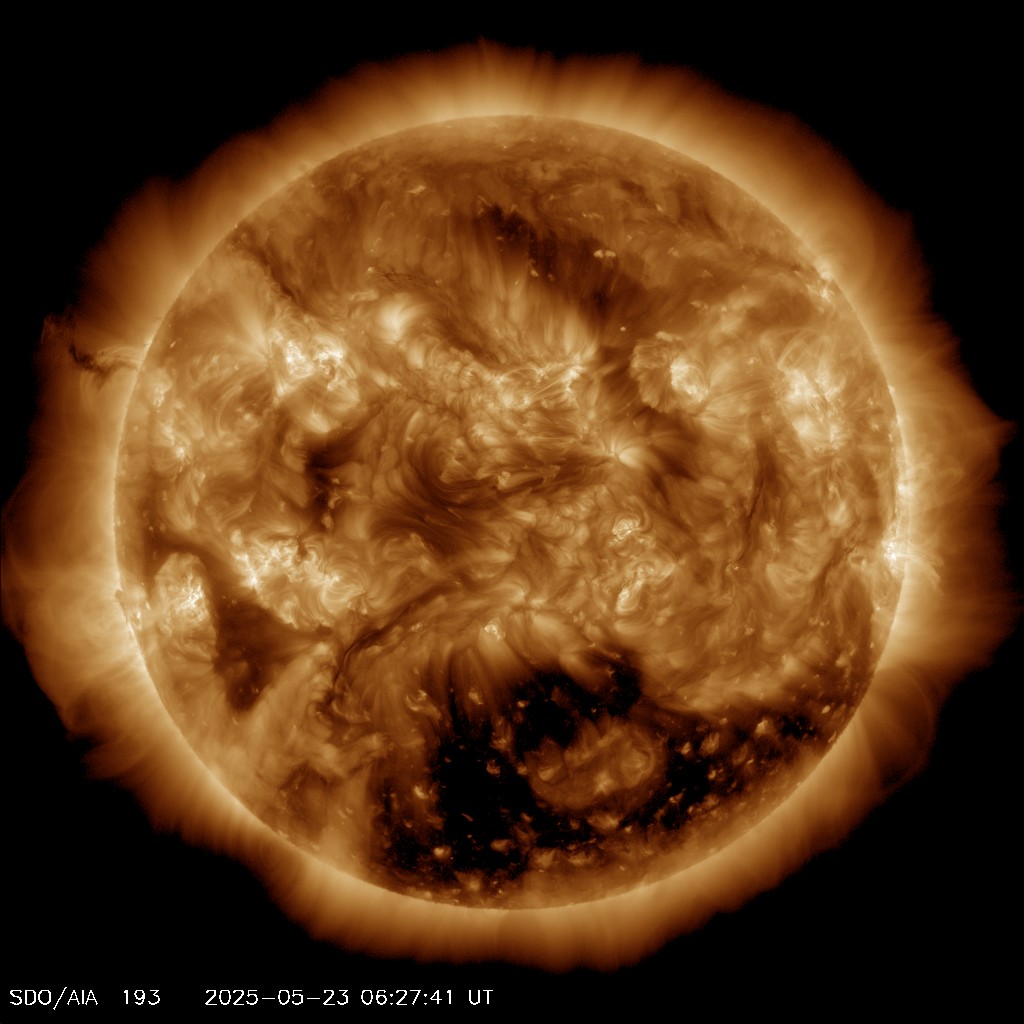
The SDO (Solar Dynamics Observatory) provides excellent imaging both of sunspots and of coronal holes, as seen in this image from February 9th, 2022. This particular wavelength also demonstrates a very low quantity of 11 times ionized iron (Fe XII) at coronal holes, and much larger quantities adjacent to active regions (brightest regions in image are near sunspots). Interestingly enough, the dark regions which emit less UV light indeed emit steady streams of high speed protons. The wavelength above and other SDO data can be viewed at https://sdo.gsfc.nasa.gov/data/.
Coronal holes are an important aspect of solar features to understand. If ever mankind expects to realize the mechanism(s) underlying the solar sunspot and polar field reversal cycles, how The Sun regularly performs these rather orderly and consistent sunspot cycles for the past 1000 years is crucial. Magnetohydrodynamics seems to play a role. What mysterious role, if any, does cosmic ray flux (associated article regarding the past 1000 years of likely solar cycles- Tree Rings Reveal 1,000 Years of Solar Activity – Universe Today ) play in the sunspot cycles?
How does the Sun so steadily complete these field reversal processes, and does it relate to cosmology? Are the Sun’s sunspot cycles a result of the field reversals, or a correlative feature? Missions like the Parker Solar Probe (https://www.nasa.gov/content/goddard/parker-solar-probe/) and ESA’s Solar Orbiter (https://www.esa.int/Science_Exploration/Space_Science/Solar_Orbiter) have already provided additional insight to the solar atmosphere and beyond. What do you think is next important discovery in heliophysics?
-Dan Nigro, a.k.a. smAshomAsh
https://smashomash.com/
February 9th, 2022
Thanks Dan,maybe the 5 state of matter. fluid matallic iron ( condenced) really These ions are very unstable but they are conained by the weak force of Gravity high temp magnetics. A Star is differant then anything else that i know of and are really in abundance. In our universe for sure.Just a thought.Well written paper. ( Its the lattice that gives it away)